Contractor Website Design: How to Get Local Leads Online
How a contractor or trades website turns an urgent local search into a booked job, and what most trades sites get wrong about speed, trust, and mobile design.
A furnace that stops working in January or a pipe that bursts on a Sunday does not leave much room for research. The customer searching for help is on their phone, in a hurry, and about to call whichever contractor looks the most trustworthy in the next thirty seconds. That is the moment a contractor website actually has to perform in.
Most trades websites were not built for that moment. They were built once as a digital business card and left alone, while the customers who need a fast, confidence-building experience keep bouncing off to the next search result. The gap between those two things is where local leads get lost.
Why speed and trust matter more than brand for trades
Home services searches are almost always high-urgency. Nobody is comparison shopping for a plumber the way they might shop for a new phone. They want someone who looks competent, licensed, and reachable right now. A slow or confusing website does not just look unpolished, it actively reads as a reason to hesitate at exactly the moment a customer needs reassurance.
This changes what “good design” means for a contractor site. It is less about visual flair and more about removing every point of friction between a stressed visitor and a phone call.
What actually gets a contractor the call
A short list of specific things determines whether an urgent visitor turns into a booked job.
- Licensing, insurance, and years in business, stated plainly. Trades customers are inviting someone into their home. A cautious visitor looks for these signals before picking up the phone, and a site that buries them at the bottom of an about page is losing an advantage it already has.
- A phone number that opens the dialer in one tap. On mobile, this should be the easiest interaction on the entire site. Anything that requires copying a number or hunting through a menu costs you calls from people who do not have the patience for it in the moment.
- Clear service structure for multi-trade businesses. A contractor covering plumbing, HVAC, and electrical needs a structure that lets a visitor confirm quickly that you handle their specific problem, not one page trying to describe everything at once.
- Service area coverage stated in real copy. If you serve several towns or a wider region, saying so directly, not just listing a phone number with an area code, helps both the visitor and Google confirm you cover their location.
- Genuine reviews near the top of the page. A specific review naming the job type and outcome does more to reassure a first-time visitor than a badge or a star rating with no context behind it.
The mobile and speed numbers behind all of this
Over 60% of Google searches now happen on mobile devices,[1] and a trades customer searching from a job site, a car, or a kitchen with water on the floor is almost certainly one of them. A site designed primarily for desktop and only adapted afterward tends to bury the two things that matter most on a small screen: what you do, and how to reach you.
Speed matters just as much. As page load time increases from one second to three seconds, the likelihood of a visitor leaving rises by 32%.[2] A customer with no heat at 11 p.m. is not going to wait on a slow website. They will already be searching for the next contractor by the time your homepage finishes loading.
What this looks like as a finished site
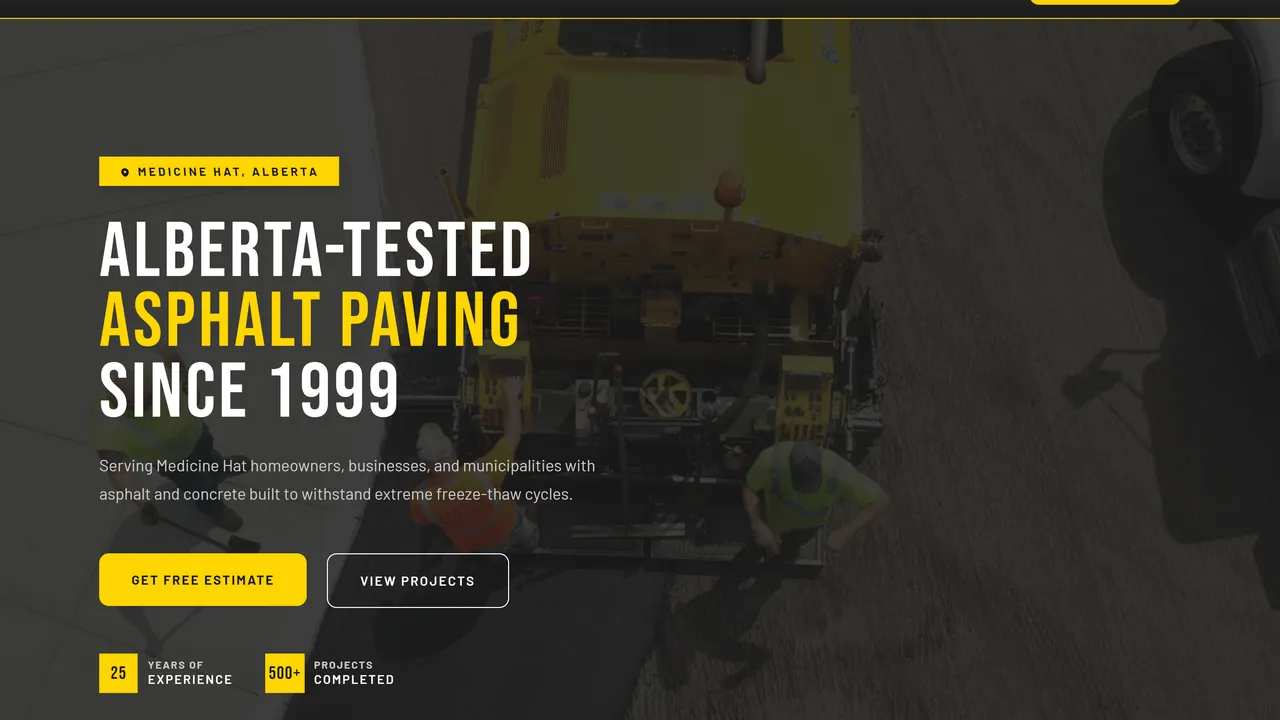
We built a concept project, Grador Paving, to show how these pieces come together for a local contractor rather than living as separate line items on a proposal. The site uses a mobile-first layout, a clear service structure, and a prominent contact path, backed by a fast, static build. It is a design study rather than a live client engagement, but it reflects the same approach we bring to real contractor and trades projects: performance and clarity working together to reduce the distance between “I found this business” and “I called them.”
Our home services industry page covers the fuller scope of what we build into contractor and trades websites, including the trust-signal placement and service-area structure this kind of business depends on.
How local SEO connects to a contractor getting found at all
A well-built site is only useful if it appears when someone searches. For contractors, that mostly comes down to local search, which is a different discipline from web design but has to be planned into the site from the start rather than bolted on afterward.
Structured data that states your service area, location-aware copy that mentions the towns or regions you actually work in, and a Google Business Profile kept consistent with your website’s contact details all feed into whether you show up for searches like “plumber near me” or “roofer [city].” Our guide to local SEO for Canadian service businesses covers this side of the equation in full, including how it works alongside a website rather than replacing the need for one.
Common mistakes that cost contractors local leads
A handful of recurring problems show up across underperforming trades websites.
- A phone number that is hard to find on mobile. If it is not visible without scrolling, a rushed visitor will look elsewhere before finding it.
- One page trying to cover every service. A wall of text listing five trades with no separation makes it harder for both visitors and Google to understand what you actually specialize in.
- No mention of service area in the actual copy. Relying on a footer address alone leaves both customers and search engines guessing about where you work.
- Outdated or missing reviews. A testimonials section that has not been touched in years signals a business that may not be as active as a competitor with recent, visible reviews.
- Desktop-first design. A site that looks fine on a laptop but is cramped and slow on a phone is failing the majority of the people who will actually try to use it.
Frequently asked questions
Should I build one website for all my services, or separate sites for each trade?
In almost every case, one well-structured website with clear, separate pages for each service performs better than multiple thin sites. Splitting your services across separate domains dilutes your local search authority instead of concentrating it, and it multiplies the amount of upkeep required.
Do I need a separate page for every town or area I serve?
Only if you have enough to say about each one to make the page genuinely useful, not just a copy of the same content with the city name swapped. A single, well-written service area section that names your coverage clearly is usually stronger than several thin location pages, which can look like spam to both visitors and search engines.
How is local SEO different from running paid ads for a contractor?
Paid ads can produce leads quickly but stop the moment you stop paying. Local SEO and a well-structured website take longer to build momentum but continue producing traffic without an ongoing per-click cost once established. Most contractors benefit from a strong website and local SEO foundation first, with ads layered in for periods when faster volume is needed.
What does a contractor or trades website typically cost?
Cost depends on the number of services, pages, and whether photography and copywriting are part of the project. Our web design pricing page breaks down how projects are typically scoped, and a discovery call is the quickest way to get a number specific to your business.
A homeowner with an urgent problem is deciding, in the space of a phone screen, whether your business looks like the one to call. The contractors who win that moment consistently are not the ones with the flashiest site. They are the ones whose site gets a stressed visitor to a phone call as fast and as confidently as possible.
If your current site is not doing that yet, our web design and development service covers how we approach contractor and trades projects from the ground up, and our home services industry page goes deeper on what we build in specifically for this category.