How Service Businesses Get Leads From Their Website
Learn how service businesses generate leads from their website: the traffic-conversion equation, the most common failure modes, and what a lead-generating site actually does.
Your website is live. People visit it. You might even have decent traffic from Google. But very few of those visitors call or email, and the ones who do tend to trickle in unpredictably rather than arriving in a steady flow.
This is not unusual. Most service business websites were built to establish an online presence, not to generate leads consistently. The two things are more different than they appear. A site that exists online tells visitors that your business is real. A site that generates leads gives them a clear reason to contact you, makes it easy to do so, and shows up in front of the right people in the first place.
This guide covers how that works in practice: where leads come from, what stops most service websites from producing them, and what a site that generates leads consistently actually does differently.
What does a lead actually mean for a service business?
Before getting into strategy, it helps to be precise about the term. A lead, for a service business, is a person who contacts you with buying intent. A form submission from someone asking about your pricing. A call from someone looking to book. A message through your website asking whether you serve their area.
That is different from a visitor. Someone who lands on your homepage and reads about your services is a visitor. They may become a lead, or they may leave. Traffic counts and page views measure how many people visit. Leads measure how many of them decided to reach out.
This distinction matters because it changes how you diagnose problems. A website that gets 2,000 visitors a month but produces 4 enquiries has a different problem than a website that gets 80 visitors and produces 4 enquiries. Understanding which side of the equation is broken is where solving it starts.
Most service businesses, when they say “the website isn’t working,” mean the leads side. Either they are not getting found, or the people who find them are not converting. Often it is some of both.
The math behind more leads
There are two levers that determine how many leads your website produces: traffic (how many visitors arrive) and conversion rate (what percentage of those visitors contact you).
The arithmetic makes the relationship concrete. If 500 people visit your website in a month and 2% of them get in touch, that is 10 leads. If you double your traffic to 1,000 visitors at the same 2% conversion rate, you get 20 leads. If instead you improve your conversion rate from 2% to 4% on the same 500 visitors, you also get 20 leads. Double both at once and you are at 1,000 visitors multiplied by 4%, which is 40 leads from the same starting point that originally produced 10.
The two levers multiply each other. Most service businesses have pulled only one of them, almost always the traffic side. The conversion rate sits wherever it landed when the site was built and stays there until someone specifically works on it.
One honest qualification: if you are getting fewer than 100 visitors a month, there is not enough volume for conversion work to matter much. Both levers need to be at a workable level. But most businesses receiving meaningful organic traffic, say 300 visitors a month or more, have untouched conversion improvements that would produce more leads faster than waiting for additional SEO gains.
For a full breakdown of how conversion mechanics work on service websites, see our complete guide to conversion rate optimization for service businesses.
Why do most service business websites fail to generate leads?
Most service websites that fail to convert share a recognizable set of problems. They are not exotic. They are predictable, diagnosable, and fixable.
-
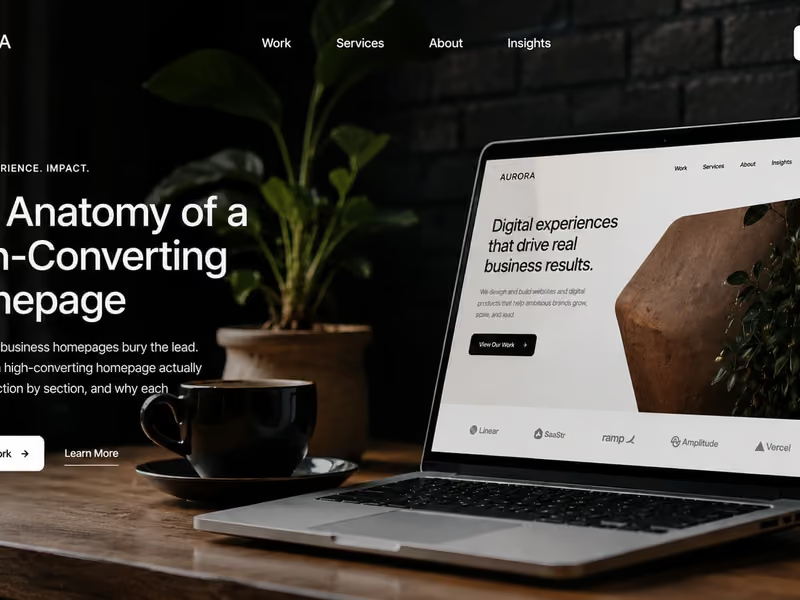
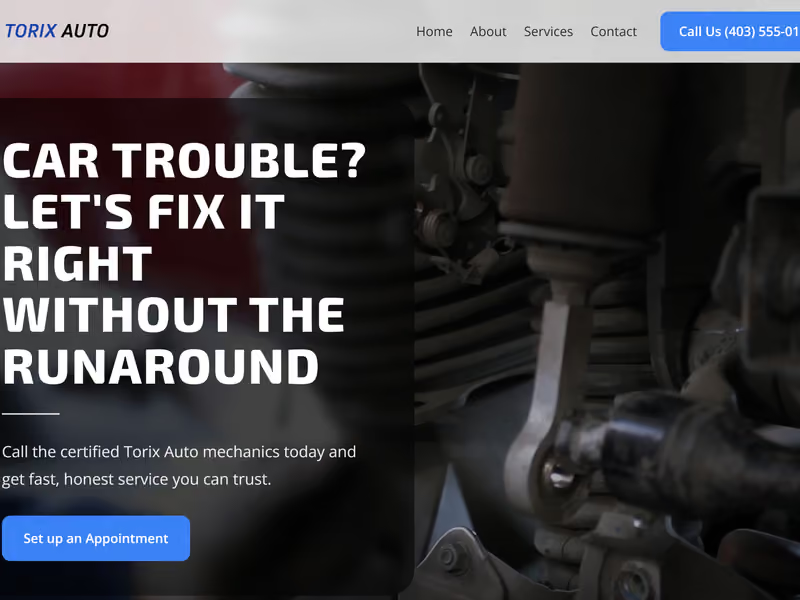
No clear message above the fold. Visitors make decisions within seconds. If someone lands on your homepage and cannot immediately understand what you do, who you help, and why they should choose you, they leave. Generic headlines like “Excellence in Service” or “Serving Our Community Since 2005” tell visitors nothing that helps them decide. Specificity is what makes people stay long enough to consider reaching out.
-
No visible path to contact. A visitor who is interested in your service still needs to be told what to do next. Websites that bury the contact link, use several competing buttons on the same screen, or label their primary action with vague text like “Learn More” lose leads the design had already earned. One clear primary action, stated plainly, consistently outperforms a menu of competing options.
-
No reason to trust yet. Service buyers are being asked to invite someone into their home, hand over their vehicle, or trust a professional with their health or finances. That level of trust does not happen automatically. A website with no real project examples, no testimonials with specifics, and no visible local presence asks visitors to take a bigger leap of faith than most are willing to take before contacting a stranger.
-
Contact friction at the last step. Many websites lose leads at the very last moment. A visitor clicks your contact page and finds a form asking for their full project scope, timeline, budget range, and preferred contact method before the conversation has even started. Every unnecessary field is friction. Every friction point costs you enquiries.
-
The website cannot be found. Lead generation from a website requires traffic. A site with strong conversion mechanics but no organic visibility, no local search presence, and no inbound paths from Google generates zero leads regardless of how well it is built. Traffic is a prerequisite, not an afterthought.
If you are already getting traffic but not seeing enquiries, why your website gets traffic but no leads covers the conversion side in more detail.
The traffic side: how potential clients find your website
For service businesses, website traffic comes primarily from local search. Two channels matter most.
Organic search is when your website ranks in Google for searches relevant to what you do. A heating company in Edmonton ranking for “furnace repair Edmonton.” A landscaper in Mississauga showing up for “lawn care Mississauga.” These rankings depend on how well your site is structured, how clearly it covers the topics your potential clients are searching for, and whether other credible websites link to it. Organic rankings take time to build, typically several months on a new site, but they compound and produce traffic that costs nothing per click once established.
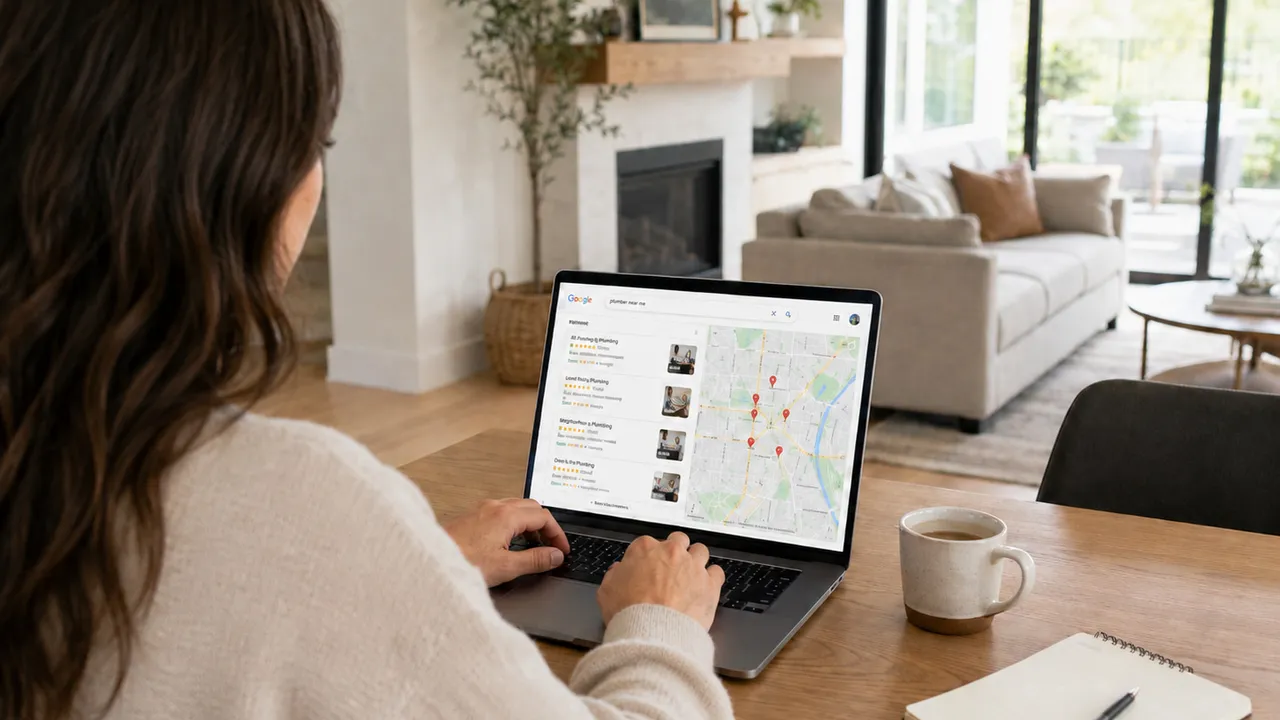
Google Business Profile and the local pack are separate from the standard web results. For local service searches, Google often shows a map block with three or four local listings before the regular results appear. These listings are powered by your Google Business Profile, not your website directly. A well-maintained GBP with consistent reviews is often the fastest path to local visibility for a service business. Your website still matters here: most people who click a local listing land on the website next, which then needs to convert them.
If you are receiving fewer than 100 visitors a month, the traffic side is where to focus first. There is not enough volume for conversion work to make a meaningful difference at that scale.
For the full picture on local search, how local SEO works for Canadian service businesses covers the strategy in depth. For your Google Business Profile specifically, how to optimize your Google Business Profile is a practical step-by-step guide.
The conversion side: turning visitors into enquiries
Once visitors are arriving in meaningful numbers, the website’s job is to convert them into leads. Four factors determine whether that happens.
-
Clarity. A visitor must be able to understand what you do and who you serve within the first few seconds. This sounds obvious and is consistently absent from most service websites. Unclear messaging is the single most common reason that visitors who would otherwise contact you do not.
-
Trust. Service buyers need evidence before they act. Real project examples, specific testimonials from real clients, and a visible local presence all reduce the perceived risk of reaching out. A website that lacks these asks for trust it has not earned.
-
A clear path to contact. One visible call to action. A contact form with as few fields as needed to start a conversation. A phone number findable on a mobile screen without hunting. Every additional step or competing option reduces the likelihood that a visitor completes it.
-
Speed and mobile usability. Most local searches happen on phones. A site that takes five seconds to load or is awkward on a small screen loses leads before a visitor has read a single word.
All four factors interact. A fast site with great social proof still fails if the contact path is buried. A visible call to action fails if the visitor has not yet seen a reason to trust you. The complete guide to conversion rate optimization for service businesses walks through each factor in depth.
What does a lead-generating website actually have?
In practice, service websites that consistently generate leads tend to have the same things in place.
-
A homepage headline that says what you do and who you help. Not a tagline, not a mission statement. A plain sentence that tells a visitor, within five seconds, whether they are in the right place. This is the most important sentence on your website and the one most often wasted.
-
Dedicated service pages for each service you offer. A homepage that lists all your services but has no separate pages for each one gives Google nothing specific to rank. A heating company needs a page for furnace installation and a separate page for furnace repair. Separate pages let you speak directly to each visitor’s intent and give search engines something targeted to index.
-
Local SEO signals throughout the site. Your city and service area mentioned naturally in the copy, a real address on your contact page, and structured data that tells Google precisely where you operate. This connects your website to local searches and reinforces your Google Business Profile.
-
Real reviews and project examples. Social proof visible near the top of your pages, not buried at the footer. A testimonial that names the client’s business type and describes a specific outcome does more work than ten vague endorsements. If you have completed real work for real clients, showing it is one of the highest-return things you can do on a service website.
-
Pages that load quickly on mobile. Most service buyers search on a phone. A site that takes five seconds to show anything meaningful loses a large portion of visitors before they have seen a word. Page speed is a lead generation problem, not just a technical metric.
-
One clear call to action on every page. Not three options competing for attention. A specific, visible invitation to take the next step, placed at the points in the page where a visitor’s intent peaks.
-
A contact path with minimal friction. Name, phone or email, and a brief description of what they need. Everything else can come in the conversation. Every required field beyond this costs you enquiries.
The specific features that drive the most conversions are covered in depth in The 7 Essentials of High-Converting Small-Business Websites. For a more concrete, buy-it-or-build-it checklist of the features themselves, see the best lead generation website features for service businesses.
A quick self-audit: how does your website stack up?
You do not need a specialized tool to start this assessment. These questions cover the most common failure points.
- Can a first-time visitor understand what your business does without scrolling?
- Does your homepage headline name who you help, not just what you do?
- Is there one clear call to action above the fold?
- Can someone find your phone number on a mobile device in under five seconds?
- Do you have at least three genuine client testimonials visible before the footer?
- Does your contact form have fewer than five required fields?
- Do you have a separate page for each service you offer?
- Does your website mention the city or region you serve in natural copy?
- Have you checked your site load time on a mobile device recently?
- Have you received a new Google review in the last 60 days?
If you answered no to three or more, those are the places your website is losing leads. Addressing them in order of impact is usually more productive than a full redesign.
Frequently asked questions
What is the fastest way to get more leads from my website?
If you are already getting meaningful traffic, the fastest path is almost always the conversion side: clarify your homepage headline, add a visible call to action, simplify your contact form. These are copy and content changes that do not require a rebuild. If you are getting very little traffic, the priority shifts to Google Business Profile and local SEO, which can produce results faster than waiting for organic rankings to build.
How many leads should my website be generating?
There is no universal number because it depends on your traffic volume, industry, and the type of enquiry. A reasonable working benchmark for a service business website is 1% to 3% conversion on organic traffic. If you are getting 300 visitors a month and fewer than 3 enquiries, something in the conversion path is likely breaking down. Knowing your current baseline is the most useful starting point for improving it.
Do I need better SEO or a better website first?
Both matter, and each has a floor below which the other stops producing results. A well-designed site with no traffic generates zero leads. A site that ranks well but has unclear messaging and a buried contact form converts very little of that traffic. For a new business, building a well-structured site and setting up Google Business Profile at the same time is usually the right approach. For an established business with existing traffic, improving the conversion side often delivers results faster.
What does a lead-generating website cost in Canada?
The range is wide because scope varies significantly. A professionally built, conversion-focused service website for a Canadian small business typically starts in the $2,500 to $5,000 range for a clean, well-structured site. The more relevant number is what a new client is worth to your business. If a typical client relationship is worth $2,000 and your website generates one additional client per month, the return on a well-built site is realized quickly.
Can I generate leads with a template website?
Yes, in many cases. A well-chosen template set up with clear messaging and a simple contact path outperforms a poorly built custom site. The limitation of templates appears when you need to fix specific conversion problems and the template makes that difficult, or when design quality itself signals credibility in your category. For most early-stage service businesses, a good template is the smarter starting investment. When the site becomes a meaningful lead source, a custom build gives you more control over the factors that decide conversion.
The service businesses that generate consistent leads from their websites have solved both sides of the equation. They get found by the right people, and when those people arrive, the site gives them a clear reason to reach out and an easy path to do it.
If you want a website built to generate leads from the start, our lead generation website design service covers exactly how we approach this. The full technical build is part of our web design and development service. If the site already exists but the leads are not coming, our conversion optimization service addresses exactly that problem. Or start with a free website audit and we will show you specifically where your site is losing leads and what the highest-impact fixes are.