Conversion Rate Optimization for Service Businesses
A complete guide to conversion rate optimization for service businesses: what CRO is, why it matters more than traffic, and the specific changes that turn visitors into leads.

Most service businesses treat lead generation as a traffic problem. Get more visitors and you get more leads. That logic is not wrong, but it is incomplete. Traffic is only one half of the equation. The other half is conversion: what percentage of those visitors actually contact you.
Conversion rate optimization, or CRO, is the practice of improving that second number. For service businesses, it is often the faster, less expensive path to more leads, because it works on traffic you already have. This guide covers what CRO actually means in a service business context, why it deserves more attention than most business owners give it, and the specific areas where the biggest improvements tend to come from.
What does conversion rate optimization mean for a service business?
In e-commerce, conversion usually means a completed purchase. In a service business, it means something simpler: someone decides to contact you. A form submission, a phone call, a booking request. That is what a “conversion” is on a service website.
Your conversion rate is the percentage of visitors who take that step. If 400 people visit your website in a month and 8 of them fill in your contact form, your conversion rate is 2%.
CRO is everything you do to move that number in the right direction. Not through manipulation or dark patterns, but by making your website easier to understand, easier to trust, and easier to act on. For service businesses, that almost always comes down to clarity, credibility, and removing friction.
The conversion rate math that changes how you think about growth
The reason CRO deserves serious attention is the arithmetic. You have two levers for generating more leads: bring more visitors to your site, or convert a higher percentage of the visitors you already have.
Say your site receives 500 visitors a month and converts at 1%. That is 5 leads. If you double your traffic to 1,000 visitors, you get 10 leads. If instead you improve your conversion rate from 1% to 3% on the same 500 visitors, you get 15 leads.
Both levers matter and they work best together. But for a business that is already getting meaningful traffic, improving conversion is often the more immediate opportunity. Traffic growth through SEO takes months. Fixing a confusing homepage headline, shortening a contact form, or adding a credible testimonial can take a day.
What are the most common conversion problems on service websites?
Most service websites that fail to convert have the same handful of problems. These are not exotic issues. They are predictable, diagnosable, and fixable.
-
Unclear messaging. Visitors make decisions in seconds. If someone lands on your homepage and cannot immediately understand what you do, who you help, and why they should choose you, they leave. Generic headlines like “Excellence in Service” or “Your Trusted Partner” tell visitors nothing. Specificity is what makes them stay. Our post on why your website gets traffic but no leads covers this problem in detail and explains how to diagnose whether messaging is where your conversions are breaking down.
-
Weak or missing calls to action. A visitor who is interested in your service still needs to be told what to do next. Websites that bury the contact link, use competing buttons on the same screen, or label their primary action with vague text like “Learn More” lose leads that the design already earned. One clear primary action, stated plainly, works better than three competing options every time.
-
Missing or weak trust signals. Service buyers are being asked to let a stranger into their home, hand over their vehicle, or trust someone with their health or finances. That level of trust does not happen automatically. Websites that lack real project examples, specific testimonials, or local contact information ask visitors to take a bigger risk than necessary. Our guide on the seven essentials of high-converting small-business websites breaks down the trust elements that matter most. A deeper breakdown of specific trust signal types and where to place them on your site is in our post on trust signals that convert visitors into leads.
-
Contact friction. Many websites lose leads at the very last step. A visitor decides they want to get in touch, clicks your contact page, and finds a form that asks for their full project scope, budget range, timeline, preferred contact method, and how they heard about you before the conversation has even started. Every unnecessary field costs you enquiries. Best practices for structuring a contact form that converts are covered in our post on contact form best practices for service businesses.
-
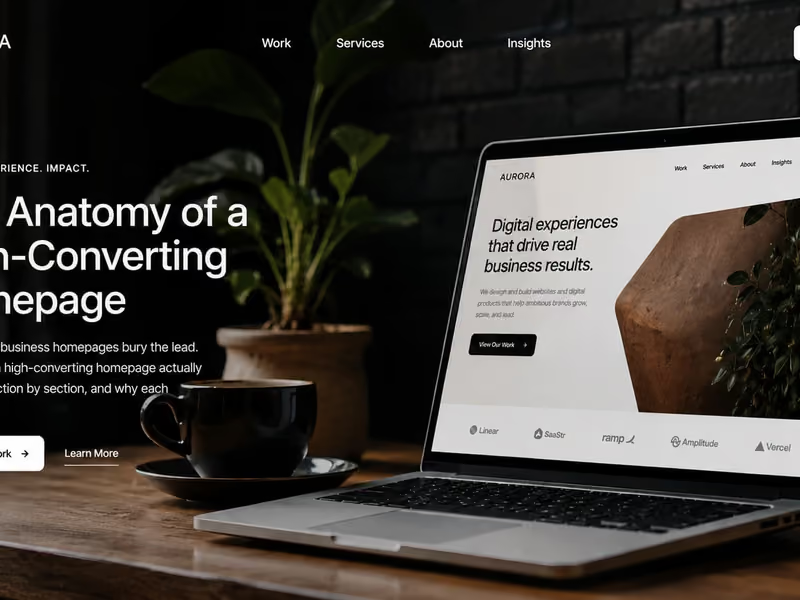
Homepage structure failures. The sections of a homepage are not interchangeable. Leading with your company story before you have established relevance loses visitors who needed to see what you do and who you serve first. The order matters. For a full breakdown of homepage structure and why each section works the way it does, see our post on the anatomy of a high-converting homepage.
The homepage is where most leads are won or lost
For most service businesses, the homepage is the highest-traffic page on the site and the primary conversion surface. It is where most visitors first decide whether to stay or leave, and whether to contact you or not.
The “five-second test” is a useful frame: if someone lands on your homepage and cannot answer three questions within five seconds (what do you do, who do you help, and what should I do next), you are losing leads. Visitors will not read carefully enough to figure those things out if the answers are not immediately clear.
A high-converting homepage answers the visitor’s questions in the right order. What do you do. Is this for someone like me. Can I trust you. What should I do next. The homepage sections that handle each of these questions, and why they need to appear in that sequence, are covered in full in the anatomy of a high-converting homepage.
What trust signals actually move conversions for service businesses?
The stakes of a service business transaction are different from buying a product online. A visitor is being asked to invite someone into their life, or trust a business with something that matters to them. That means trust is not a nice-to-have element of your website. It is a prerequisite for conversion.
The trust elements that work hardest on service business websites are:
-
Real project examples. Showing actual work you have done, with enough context for a visitor to see themselves in it, is more persuasive than any claim you can write about yourself. A before-and-after photo, a case study with the client’s business type, or a portfolio entry with a specific outcome all help a visitor answer the question: “Have they done this for someone like me?”
-
Testimonials with specifics. A quote that names the business type, the problem, and the result is worth more than a general endorsement. “They completely transformed our online presence” is less credible than a testimonial from a real business owner that says what the service actually solved.
-
Local signals. A real phone number, an address, and evidence that you actually operate in the area you claim to serve all build ambient trust. Visitors to a Canadian service business want to know you are reachable, accountable, and local.
-
Consistent, professional presentation. Design quality signals operational quality. A website that looks outdated, loads slowly, or has obvious errors raises quiet doubts before a visitor has read a word.
For a full breakdown of what these signals are and where to place them on your site, see the seven essentials of high-converting small-business websites. For a dedicated breakdown of which trust signals work hardest for service businesses and how to place them, see our post on trust signals that convert visitors into leads.
Contact paths and friction
A visitor who has decided to reach out is the highest-value moment on your website. Anything that makes that step harder than it needs to be is directly costing you leads.
The most common friction points at the contact stage:
-
Forms that ask too much too soon. A contact form is not a scoping document. Its job is to start a conversation, not gather every detail before you agree to respond. Name, email or phone, and a brief description of what they need is usually enough. Everything else can come in the conversation.
-
Poor mobile experience. Most local search happens on phones. If your contact form is hard to complete on a small screen, requires scrolling past a navigation bar that covers the submit button, or uses tiny tap targets, you are losing leads from your most common device.
-
No expectation-setting after submission. A visitor who clicks Submit and sees a blank page, a generic “thanks,” or nothing at all does not know what happens next. Telling them you will respond within one business day, or what the first step looks like, removes a common anxiety that sometimes causes people to simply not submit.
A full breakdown of contact form best practices for service businesses covers what to include, what to leave out, how to design a form that converts, and what should happen after someone submits.
Page speed and technical performance
Speed is a conversion factor because slow pages create friction before a visitor even sees your content. On a mobile device with variable signal quality, a site that takes five seconds to display anything meaningful loses a significant portion of visitors who might otherwise have converted.
The relationship between load time and lead volume is not linear, but the direction is consistent: faster sites convert more visitors than slower ones, all else being equal. Technical performance is not a separate concern from conversion. It is a conversion problem.
The connection between page speed and lead generation is covered in detail in an upcoming post (backfill: page speed and conversions).
How do you audit your own website’s conversion rate?
You do not need a specialized tool to start diagnosing where your conversions are breaking down. These questions cover the most common failure points:
- Can a first-time visitor understand what you do and who you serve without scrolling?
- Is there one clear primary call to action on your homepage, or are there several competing options?
- Is there social proof visible before the scroll, or is it buried at the bottom of the page?
- How many fields does your contact form ask for?
- Does your site load quickly on a phone?
- Does your homepage explain what happens when someone gets in touch?
- Is your phone number visible without searching for it?
Working through these questions honestly usually reveals where the biggest opportunities are. A structured website audit checklist that covers conversion, SEO, and performance in detail is coming soon (backfill: website audit checklist for service businesses).
Quick wins versus structural fixes
Some conversion problems are copy and content fixes that do not require rebuilding anything:
- Rewriting a vague headline to be specific about what you do and who you serve
- Removing optional fields from a contact form
- Adding a real testimonial to the homepage
- Moving your phone number to the top of the page
- Changing a button label from “Submit” to “Request a Free Quote”
These changes can be made without touching the underlying structure of the site, and they often produce real results.
Other problems are structural. If the homepage template makes it impossible to control the order of sections, if the platform cannot be optimized for mobile performance, or if the navigation is confusing in a way that page-level edits cannot fix, the underlying structure is the constraint. In those cases, targeted updates will always be fighting the foundation.
The honest diagnostic: if you find yourself making the same type of fix repeatedly across multiple pages, or if fixing one problem would require restructuring most of the site, you are likely dealing with a structural issue rather than an isolated content problem. Our web design service for service businesses is built around getting the structure right from the start.
When professional CRO help is worth the cost
For a service business where the website is the primary source of new clients, improving your conversion rate compounds over time. A higher conversion rate means more leads from every unit of traffic, which means your SEO investment, your advertising, and your word-of-mouth referrals all produce more return.
The case for professional CRO help is strongest when you have meaningful traffic but the leads do not reflect it, when you have made several targeted changes without seeing improvement, or when you want an outside perspective on where visitors are dropping off.
Our conversion optimization service is built for service businesses in exactly this situation. If you want to start with an outside look at where your site stands, a free website audit covers the main conversion, performance, and SEO factors and shows you where the biggest opportunities are.
Frequently asked questions
What is a good conversion rate for a service business website?
There is no universal benchmark because conversion rates vary significantly by industry, traffic source, and the type of enquiry. Paid traffic typically converts at lower rates than direct or referral traffic. High-ticket services with longer sales cycles convert differently from transactional services where visitors are ready to book immediately. What matters more than an industry average is understanding your own baseline and improving on it consistently over time.
Should I focus on CRO or getting more traffic first?
If you are already getting a meaningful number of visitors but not many leads, CRO is usually the faster opportunity. Improving the conversion rate of existing traffic produces results faster than waiting for new traffic from SEO or paid channels to accumulate. If you have very little traffic, the calculus shifts: there is a floor below which conversion work produces too few additional leads to matter. In most cases, both should be worked on in parallel rather than in strict sequence.
Can I improve conversions without a full website redesign?
Yes, in many cases. Targeted changes to the headline, calls to action, contact form, and trust signals can produce real improvements without touching the underlying structure. The situations that genuinely call for a full rebuild are ones where the structure itself is preventing the changes that would matter most, such as when the template makes it impossible to control section order, or when the platform cannot perform adequately on mobile.
How do I know if my website has a conversion problem?
If you are getting traffic but very few enquiries relative to your visitor count, the problem is almost certainly conversion rather than visibility. You can confirm this by checking your traffic in Google Search Console or Google Analytics: if visitors are arriving but not contacting you, the website is not doing its job. If very few people are arriving at all, the issue is visibility.
What is the difference between CRO and web design?
Web design establishes the structure, layout, content, and visual presentation of your site. CRO is the ongoing practice of measuring and improving how many visitors take the action you want them to take. Good web design should be built with conversion as a primary goal from the start. CRO often picks up after launch, identifying where visitors drop off and testing changes that improve the result. The two are complementary: a well-designed site is easier to optimize, and CRO findings often inform better design decisions over time.
Conversion rate optimization is not a complicated discipline. For service businesses, it comes down to a clear question: of the people who visit your site, how many decide to contact you, and what is stopping the rest?
The answer is almost always a combination of the same factors: unclear messaging, missing trust, friction in the contact path, and a homepage that does not move visitors through their questions in the right order. None of those are exotic problems. All of them are fixable.
More traffic is only valuable when the website converts it. If you want to understand what is limiting your site’s lead volume, request a free website audit and we will show you what we find. Or explore our conversion optimization service if you are ready to work through it together.